

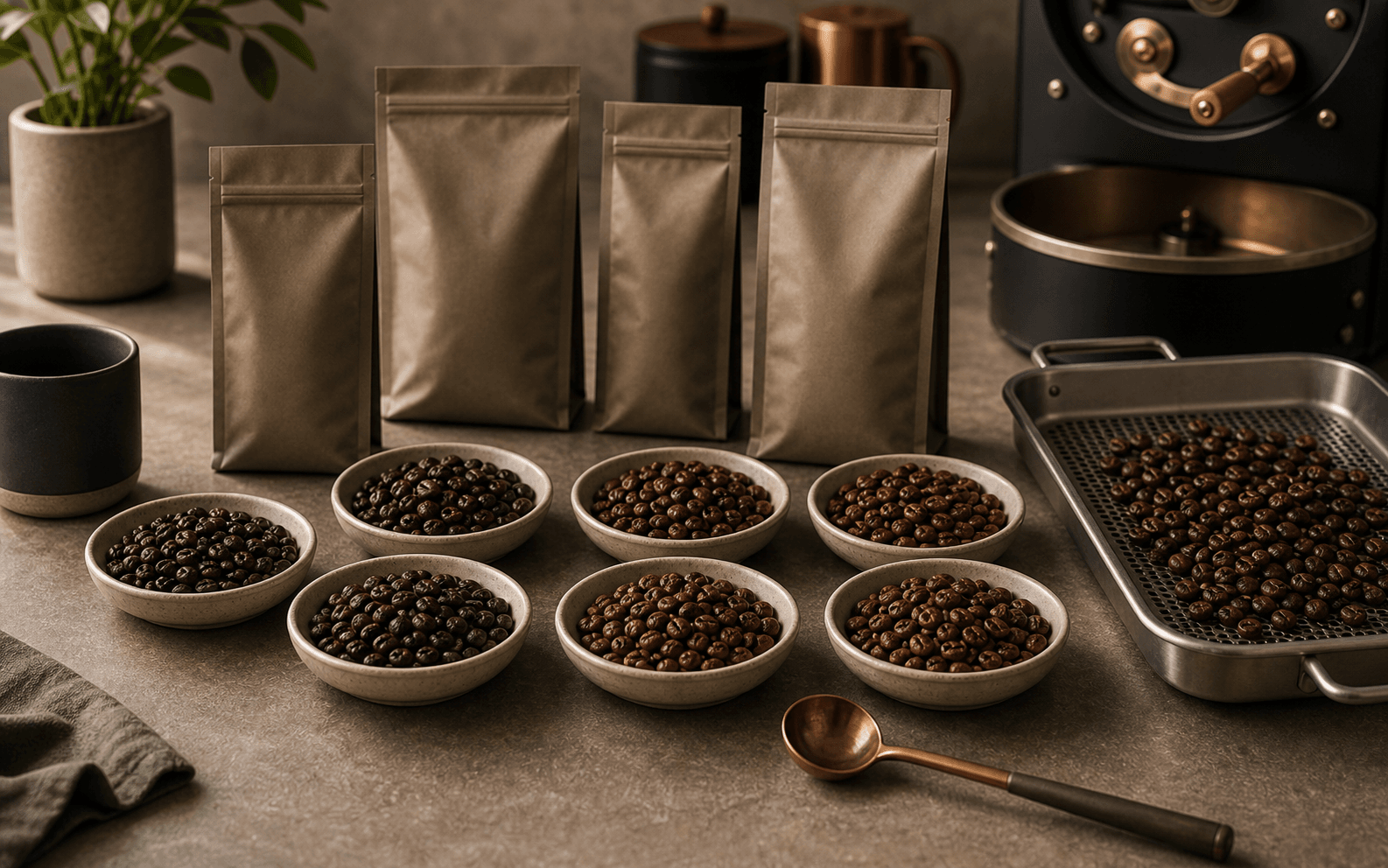
A specialist roast profile is a roast approach built for a specific coffee, not a generic light, medium or dark setting.
Two coffees can both be speciality grade and still need different heat application, development and flavour targets. That is why Out of Coffee treats roast profile as part of product design.
Internal roast testing, not preset roasting
The image below is a small example from our own roast-testing software. It is not the full test history; it simply shows how we compare different profile directions, roast paths and measured responses when we are trying to shape a coffee.
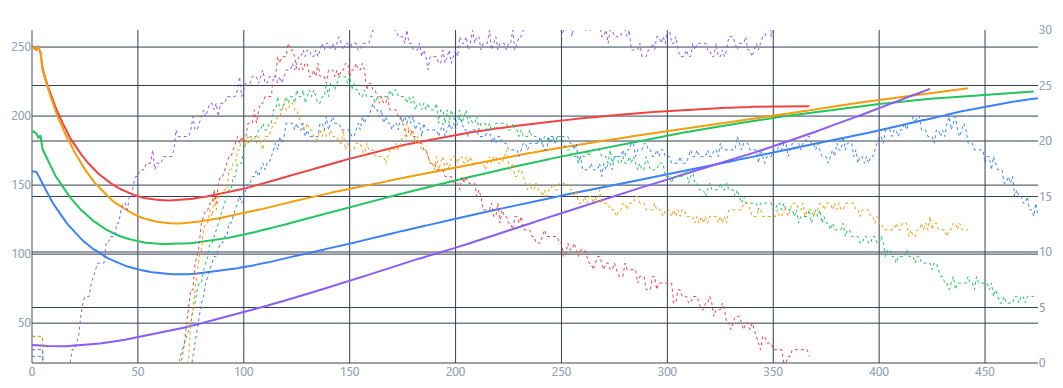
Some trials are intentionally outside the obvious route. We test different heat applications, development windows and profile shapes because small changes can shift sweetness, acidity, texture and roast character. The goal is not novelty for its own sake; it is to find the most useful profile for that lot and brew intent.
That is why profile work can include ideas that look unusual on a graph. They help us learn where a coffee opens up, where it becomes flat, and where the balance starts to move away from the cup we want.
Roast degree changes flavour
Research consistently shows that roast degree strongly affects sensory outcome. Lighter roasting can preserve more acidity and origin character. More development can increase chocolate, roasted, nutty and bitter impressions.
This is not a moral ranking. It is a design choice. The roast should serve the coffee and the intended use.
Development also matters
Even when roast colour is similar, development time and roast path can change sweetness, acidity, fruit expression and roasted character.
That means a profile is more than an end colour. The path matters because the chemistry changes along the way.
Different origins respond differently
A dense East African washed coffee does not behave like a natural Brazil or a decaf Colombia. Process, moisture, density, screen size and flavour target all affect roast decisions.
One generic profile applied to every lot is easier operationally, but it is not the most respectful way to roast speciality coffee.
Brew method belongs in the roast decision
A coffee intended for filter clarity may not need the same development as a coffee intended for milk drinks or automatic machines. Roast profile should consider how the customer will brew the coffee.
- Lot-specific roasting protects origin character.
- Roast degree changes sensory balance.
- Development changes sweetness, acidity and roast notes.
- Brew method helps define the target.
What changes from lot to lot
A roast profile can change charge temperature, heat application, airflow, development time, end temperature, rate-of-rise behaviour and batch handling. Those changes are not decoration. They affect how sweetness, acidity, body, aromatics and roast character show in the cup.
For a clean filter-focused lot, we may protect clarity and keep roast character quieter. For a milk-friendly or automatic-machine coffee, we may prioritise body, chocolate, nuts and a smoother finish. For an expressive coffee in the Explorer range, the profile has to reveal character without letting acidity become sharp or aromatics become messy.
What we do not mean by specialist roasting
Specialist roasting does not mean chasing extreme light roasting, forcing every coffee to taste unusual, or pretending that roast graphs are more important than the cup. The graph is a tool. Cupping, brew testing and customer use decide whether the profile works.
A profile is only successful if the coffee tastes better for the person who will brew it. That is why brew method, resting window and flavour lane belong in the roast decision.
How roast profiles show up for customers
Customers do not need to read a roast curve to benefit from profile work. They experience it as sweetness, balance, clarity, body, lower harshness and better brew fit. A good profile makes the product description more trustworthy because the cup supports the promise.
That is why the same lot may be tested for more than one direction before release. We are not only asking whether the coffee is good. We are asking what use it should serve: filter clarity, espresso sweetness, automatic-machine comfort, milk compatibility or a more expressive Explorer experience.
Read next
- How brew method changes coffee flavour
- Coffee tasting notes explained
- No artificial flavouring. Just true coffee character.
- Roast date vs drinking window
Research Papers, Sources and further reading
This guide is written for customers, not as an academic paper. It is based on Out of Coffee research notes and the source areas below.
- Roasting Conditions and Coffee Flavor: A Multi-Study Empirical Investigation.
- The Effect of Roast Development Time Modulations on the Sensory Profile and Chemical Composition of the Coffee Brew as Measured by NMR and DHS-GC-MS.
- Influence of provenance and roast degree on the composition of potent odorants in Arabica coffees.
- Coffee Flavor: A Review.