

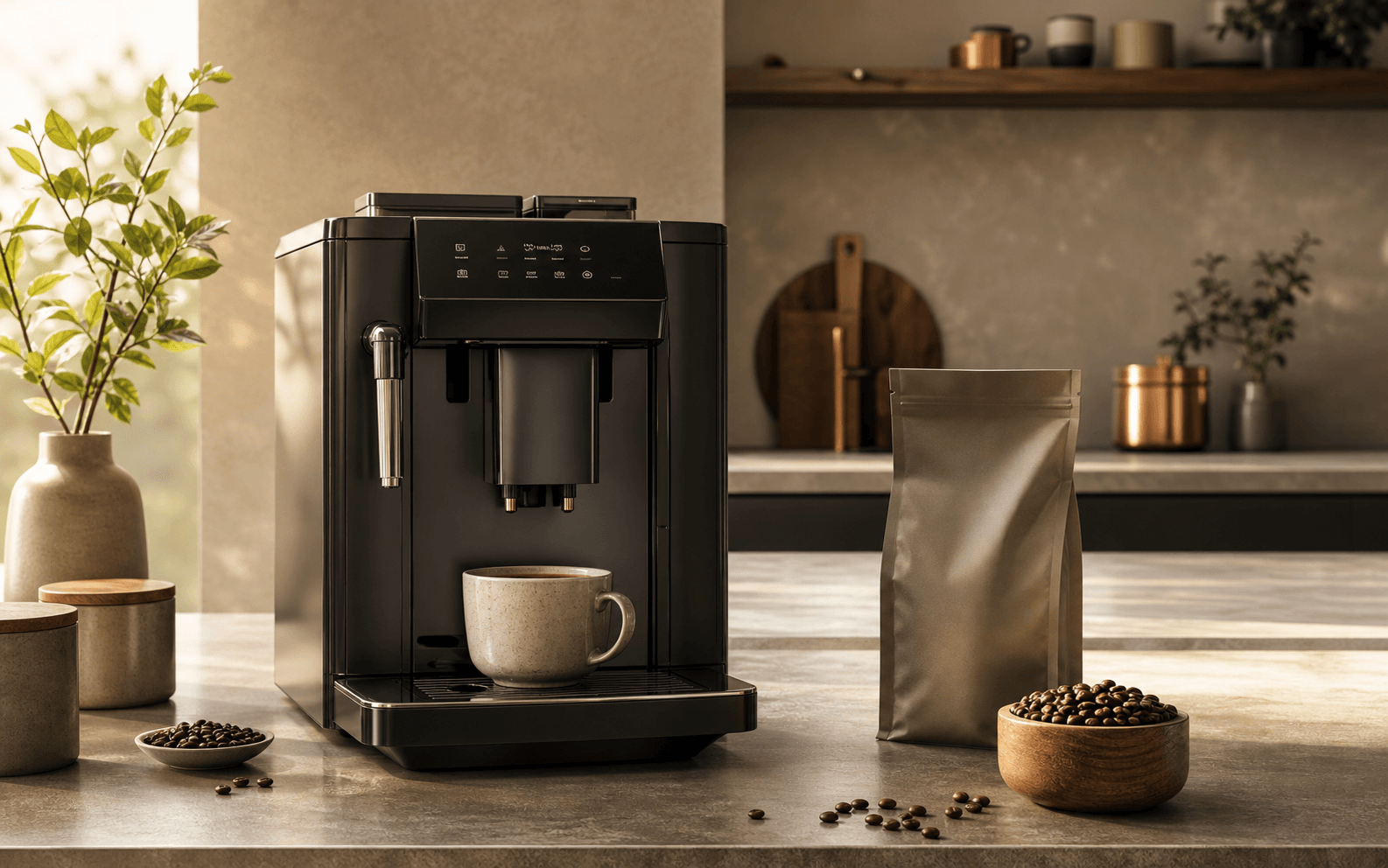
Automatic machines are useful because they make coffee convenient. They grind, dose and brew with little effort, which makes them practical for homes, offices and customers who want a dependable daily cup without building an espresso routine.
The trade-off is control. An automatic machine can produce good coffee, but it usually gives you less precision over grind, puck prep, temperature, pressure behaviour, yield and extraction than a serious espresso setup. The best coffee for that environment is not always the most complex lot on the shelf. It is the coffee the machine can brew consistently.
What automatic machines do well
Automatic machines are good at repeatability, speed and low-friction routine. They are useful when several people need coffee from the same machine, when milk drinks matter, or when convenience is more important than fine recipe control.
They usually work best with coffees that have rounded sweetness, body and lower sharpness. Chocolate, nuts, caramel, cocoa, gentle fruit and a smooth finish are safer starting points than fragile floral acidity or highly fermented fruit.
Where they struggle
Many automatic machines use built-in grinders, compact brew groups and simplified recipes. Some struggle with very light roasts, high acidity, dense beans or coffees that need careful dial-in. A coffee that tastes excellent in filter or manual espresso can taste thin, sour or muted in the wrong automatic setup.
This is not a fault in the coffee. It is a fit problem. Brew method matters because extraction conditions change the cup.
Why the mechanism changes the coffee choice
A fully automatic machine is not just a small espresso setup. It usually uses a compact brew group with a fixed screen or sieve, a puck path you cannot inspect, and less control over tamping, headspace, distribution and yield than a portafilter basket. Those parts are designed to keep the machine reliable for daily use, not to give the same narrow adjustment window as a manual espresso workflow.
That is why the grinder range matters. Even on the finest setting, most automatic machines are still working inside the grind window the machine can move water through consistently. True espresso-fine coffee, especially if it carries a high share of fines, can reduce bed permeability, slow flow, lengthen extraction or block the coffee path. Manufacturers describe this in practical terms as coffee ground too fine, slow delivery, blocked funnels, or the need to move the grinder coarser.
A useful starting point is to set the machine as fine as it can comfortably run, then watch the flow. For many automatic machines, the finest setting is the normal baseline rather than an extreme espresso setting. If the pour becomes very slow, the machine strains, coffee drips unevenly, or the brew path blocks, move one step coarser and test again. The goal is the finest reliable setting for that specific machine, coffee and cleaning condition.
The basket or screen question fits into the same idea. A precision espresso basket gives a barista control over basket size, puck depth, dose, distribution, tamping and puck resistance. In an automatic machine, the brew unit, screen or sieve and puck compression are mostly fixed. Because you cannot tune those variables the same way, the coffee has to be forgiving inside the machine’s built-in limits.
This is the practical reason chocolate, cocoa, nut, caramel, body and roast sweetness often work so well in automatic machines. Those flavours tend to stay present when the machine extracts a little less precisely, runs a coarser grind window, or dilutes the cup into milk. Delicate floral, citrus and very bright fruit notes can still work, but they are easier to lose or flatten if the machine cannot extract them cleanly.
What to buy first
Start with Easy Drinking coffees, especially if you use milk or want broad daily reliability. Look for product notes that mention chocolate, nuts, caramel, cocoa, body or automatic-machine suitability. These coffees give the machine a better chance of producing a balanced cup without constant adjustment.
Move into the Explorer range only when you know how your machine handles acidity, grind sensitivity and lighter roast profiles. If your machine has strong grinder control and you are willing to adjust settings, you can experiment more. If it is a simple office or home machine, comfort usually wins.
Setup choices still matter
Use fresh whole beans where possible, keep the hopper clean, and do not leave large volumes of coffee sitting in a warm hopper for weeks. Grind settings, milk texture, cleaning cycles and water quality all influence the final result.
If your machine lets you adjust strength, temperature or grind, make one change at a time. If the cup is sour and thin, try a finer grind or higher strength. If it is bitter and harsh, try a coarser grind or lower strength. Keep notes until you find the setting that suits the coffee.
Automatic machine buying guide
- Choose rounded, forgiving coffees first.
- Prioritise Easy Drinking for milk drinks, offices and shared machines.
- Use the Explorer range only when the machine gives enough control.
- Store beans well and avoid stale hopper coffee.
- Judge the cup, not only the SCA score or tasting-note complexity.
Milk drinks and automatic machines
Many automatic-machine customers drink milk-based coffee. Milk changes the buying decision because acidity and delicate aromatics are often softened, while body, chocolate, nuts, caramel and roast sweetness remain easier to perceive. A coffee that is subtle and floral as a black filter cup may disappear in milk from an automatic machine.
For cappuccino, flat white or office-style milk drinks, choose coffees with enough body and sweetness to stay present after dilution. This does not mean dark or bitter. It means balanced, rounded and structurally strong enough to hold its shape.
Office and shared-machine buying
For a shared machine, avoid buying only for the most adventurous palate in the room. Office coffee needs to work across different preferences and cup sizes. Easy Drinking coffees are usually the strongest default because they reduce complaints about sharpness, sourness or strange fruit notes.
If you want variety, keep one safe daily coffee and add a smaller Explorer bag for people who actively want more expressive black coffee. That gives choice without forcing every cup through the same high-variance profile.
When to experiment with the Explorer range
the Explorer range can work in automatic machines when the machine has decent grinder adjustment, the coffee is rested properly, and the user is willing to change settings. Start by using smaller bags. Keep notes on grind, strength and cup size. If the cup tastes thin, sharp or hollow, the coffee may need a different grind, more rest, or a different brew method.
The mistake is assuming a more complex coffee will automatically produce a better automatic-machine cup. Complexity has to survive the machine.
Common mistakes to avoid
Do not leave beans in the hopper for weeks. Do not buy very large bags if the coffee will sit warm and exposed. Do not judge a coffee from one machine setting. Do not chase the highest score if the flavour direction is wrong for the machine.
Choose the coffee that fits the real routine, then store and brew it with enough care for the machine to do its best work.
Read next
- How brew method changes coffee flavour
- Easy Drinking vs Explorer range
- Choosing coffee for espresso setups
- Shop automatic-friendly coffee
Research Papers, Sources and further reading
This guide is written for customers, not as an academic paper. It is based on Out of Coffee research notes and the source areas below.
- Coffee extraction: A review of parameters and their influence on the physicochemical characteristics and flavour of coffee brews.
- Comparison of nine common coffee extraction methods: instrumental and sensory analysis.
- Roasting Conditions and Coffee Flavor: A Multi-Study Empirical Investigation.
- The role of fines in espresso extraction dynamics.
- Systematically Improving Espresso: Insights from Mathematical Modeling and Experiment.
- De'Longhi Dinamica support: Ground too fine, Adjust mill.
- Philips Support: My Philips Espresso Machine does not grind coffee beans.