

Espresso is often treated as a grind-size problem. Grind matters, but it is not the whole story. One of the biggest changes we have seen in cup quality comes from something quieter: the amount of space left above the tamped puck once the portafilter is locked into the machine.
That space is usually called headspace. It sits between the surface of the prepared coffee puck and the shower screen or dispersion setup above it. When the headspace is excessive, the puck has more room to swell, move, fracture and behave differently from shot to shot. When the headspace is too tight, the shower screen can crush the puck, block flow, or make the dose impractical for that basket and coffee.
Our practical target is simple: after dose, distribution and a firm level tamp, a clean spacer such as a South African R2 or R5 coin should leave a shallow dent on the dry puck when the portafilter is locked in fully and removed. Not a deep crater. Not no mark at all. A small, clear indentation tells you the puck is close to the shower screen while still leaving a little working room.
That test shot should not be served. The test is there to establish your dose and basket fit. Once you know the gram weight that creates that shallow dent, you can remove the coin, prepare the next shot normally and use that dose as your baseline.
Why headspace matters more than the basket label
A basket labelled 18 g, 20 g or 22 g is a useful starting point, not a final recipe. Different coffees occupy different volumes at the same weight. Roast level, bean density, grind size, retained fines, age after roast and how the grounds are distributed all change how high the puck sits in the basket.
This is why two coffees can behave differently at the same dose in the same basket. One may sit lower and leave too much headspace. Another may sit higher and touch the screen too aggressively. If you only follow the basket rating, you can miss the physical fit of the puck inside your actual machine.
Espresso is a pressurised flow through a compacted porous bed. The water does not politely pass through every part of the puck in equal measure. It follows resistance. Any change in puck height, compression, fines migration, cracks, edge gaps or uneven saturation can change the path of the water.
That is the practical reason headspace is worth testing. It affects the conditions under which the puck first meets water and pressure. When the puck starts more consistently, the shot has a better chance of pulling consistently.
The shallow-dent test
The aim is not to force the puck into the shower screen. The aim is to find a dose where the puck is close enough that the available headspace is controlled, but not so close that the puck is crushed or the basket is overfilled.
- Grind and dose your basket as you normally would.
- Distribute carefully and tamp firmly with a level tamp.
- Place a clean R2/R5-style coin or consistent thin spacer on top of the dry puck.
- Lock the portafilter fully into the group head, using the same final position you use when pulling a shot.
- Remove the portafilter without brewing.
- Look at the puck surface. You want a shallow, visible dent.
If there is no mark, your puck is probably sitting too low for that basket, coffee and machine combination. Increase the dose slightly and test again. If the spacer is pressed deeply into the puck or the puck surface looks heavily crushed, you are probably too close. Reduce the dose slightly and test again.
Once you find the dose that gives the shallow dent, weigh it and write it down. That number becomes your basket-and-coffee baseline. It is not a universal rule for every coffee forever, but it gives you a repeatable starting point.
The shot used for the coin test is sacrificed because the puck has been disturbed. Pull the next shot without the spacer.
What the test is really controlling
The coin test is not magic. It is a practical measurement of clearance. It gives you a simple way to connect dose, basket depth, puck volume and machine geometry.
Too much headspace can make the beginning of the shot less controlled. The puck can expand into the available space as water arrives. That early movement can disturb the puck surface and encourage uneven flow. In the cup, this can show up as hollowness, sharpness, muddiness, fast blonding or shots that alternate between good and frustrating with very small recipe changes.
Too little headspace creates the opposite problem. If the coffee is jammed into the shower screen before brewing, the puck can be damaged before extraction starts. Flow can choke, the screen can imprint too aggressively, and the recipe becomes difficult to repeat because tiny dose changes have a large mechanical effect.
The shallow dent sits between those extremes. It suggests the puck is close to the screen, but not being smashed into it. In our testing, this has made espresso taste more complete, pull more predictably and respond more logically to grind and yield adjustments.
Our puck-prep routine
Headspace only helps if the puck itself is prepared consistently. If the puck is uneven, cracked or tamped at an angle, the best dose in the world will still behave badly.
Our routine is built around removing avoidable puck-prep variation before judging the coffee.
- Grind directly into the basket or dosing cup with the target dose weighed accurately.
- Use gentle vibration to settle the grounds without stirring or creating deep channels.
- Use a distributor only at a very shallow setting so it levels the surface without carving into the puck.
- Tamp firmly with a level tamper that indexes on the basket, so the tamp angle is repeatable.
- Optionally add a stainless mesh or puck screen on top for another layer of consistency.
- Optionally apply a very light water spray to the top surface before locking in, then test whether it improves your shots.
The shallow distributor point matters. Deep distribution tools can look neat while disturbing the puck underneath. We prefer the distributor to tidy the surface only, then let the level tamp do the compression work.
We also prefer a very firm tamp. Once the puck is fully compressed, tamping harder does not keep changing the bed in a useful way, but tamping inconsistently can change your puck height and resistance. The target is not theatrical pressure. The target is a firm, level, repeatable tamp every time.
Why level tamping is not optional
A slanted tamp creates different puck depths across the basket. One side sits closer to the screen, the other side sits lower, and the water sees different resistance across the bed. That can make a shot look acceptable while still tasting thin, harsh or inconsistent.
This is why we favour tampers that help keep the press level against the basket. Manual tampers can work beautifully in skilled hands, but if your results are inconsistent, the tamp angle is one of the first variables to remove.
When the dose, headspace and tamp angle are all repeatable, grind changes become easier to understand. If the shot runs fast, you can grind finer with more confidence. If the shot chokes, you can grind coarser or adjust yield without wondering whether the puck was simply prepared differently.
Basket size and coffee density
Precision baskets are useful because they can improve hole consistency, shape and flow behaviour, but they do not remove the need to test fit. A 14/16 g basket and a 20/22 g basket are physically different tools. They will not want the same dose, and they may not suit the same coffee equally well.
A darker, more porous coffee may occupy more volume at a given weight. A denser, lighter coffee may sit lower at the same weight. Finer grinding can pack differently from coarser grinding. Fines can change permeability and flow resistance. The number on the basket cannot account for all of that.
Use the basket rating to choose the right range. Use the shallow-dent test to find the dose that fits your machine. Use taste to decide whether the recipe is actually better.
Puck screens and surface wetting
A puck screen or stainless mesh can help make the water contact the top of the puck more evenly and keep the shower screen cleaner. It also changes the physical stack height inside the basket, so it becomes part of the headspace calculation.
If you add a puck screen, repeat the shallow-dent test with the screen included. Do not set your dose without the screen and then add the screen afterward without checking clearance. The extra thickness can turn a good dose into an overfilled one.
Lightly misting the puck surface before brewing is another testable option. The idea is to begin surface saturation more gently, but it is not guaranteed to improve every machine or every coffee. Try it against a control shot and judge the cup, not the theory.
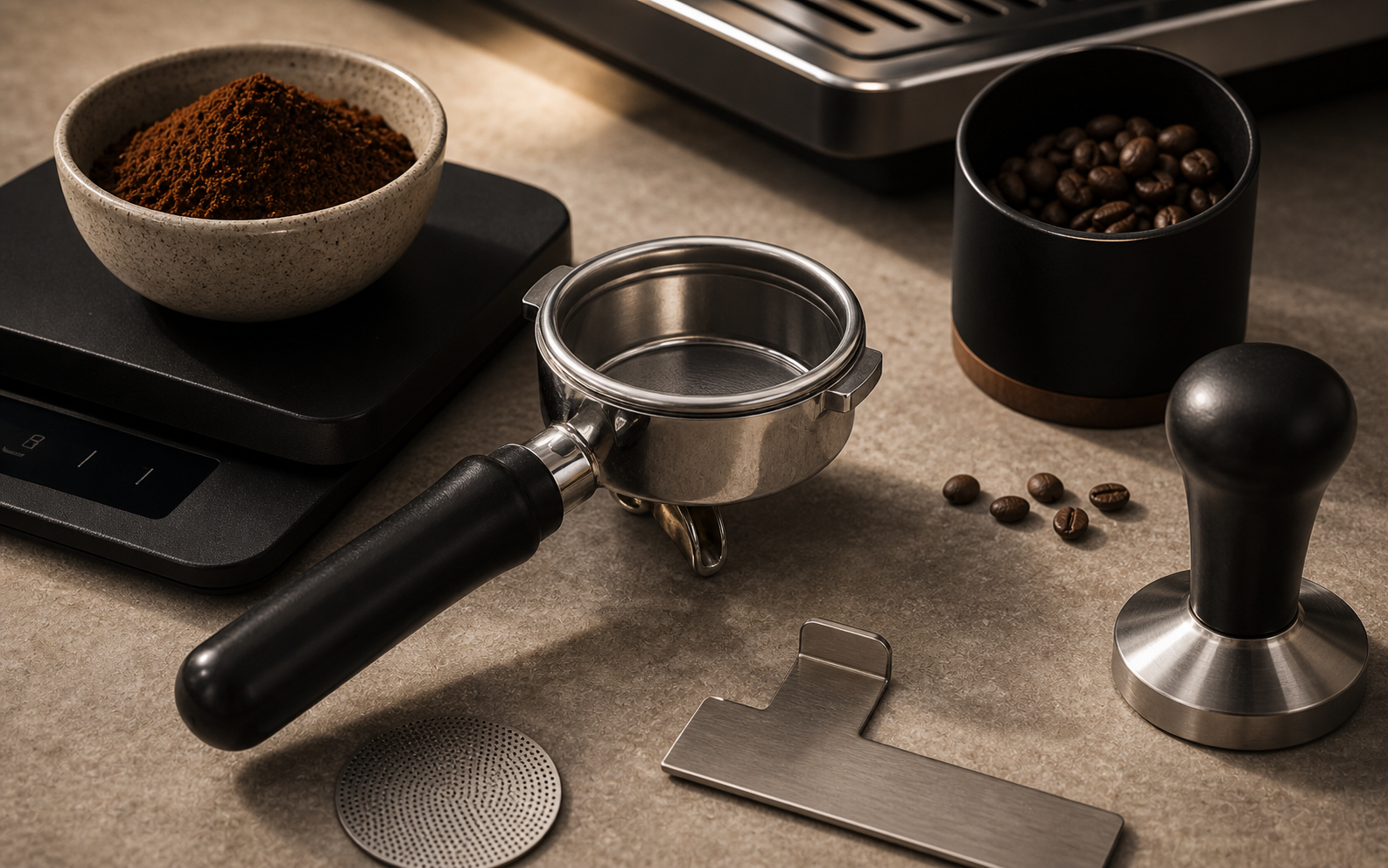
Tools used in our test routine
These are examples of the kind of tools used in our testing routine. They are not mandatory purchases, and equivalent tools can work if they help you control the same variables.
- Level / calibrated-style tamper example for repeatable, level tamping.
- Vortex / tattoo ink shaker example for gentle vibration settling. Keep non-coffee tools clean, dry and away from direct contact with the coffee bed.
- IMS 14/16 g double 58 mm basket as an example of a smaller precision basket range.
- IMS 20/22 g triple 58 mm basket as an example of a larger precision basket range.
The key is not the brand of the tool. The key is whether the tool helps you make the puck more repeatable without creating new damage or hidden variation.
How to test it properly
There are many claims in espresso. Some are useful. Some are repeated because they sound plausible. The only way to know whether a change helps your machine is to test it cleanly.
- Change one variable at a time.
- Keep the coffee, basket, dose, grinder, yield and temperature stable while testing headspace.
- Use the same tamping method for every comparison.
- Pull more than one shot before making a decision.
- Taste blind if possible, or at least taste without looking at the shot first.
- Record dose, yield, time, basket, screen use and cup result.
If the shallow-dent dose produces a sweeter, fuller and more consistent espresso across several shots, keep it. If your machine or basket behaves differently, adjust. Machines differ, baskets differ and coffees differ. The method is a way to find your best baseline, not a commandment.
What the science supports
There is strong scientific support for the broader idea that espresso extraction is sensitive to the physical structure of the coffee bed. Research on espresso and coffee extraction repeatedly points to particle size, fines, permeability, bed structure, compaction, flow and extraction uniformity as important variables.
There is less direct peer-reviewed research on the exact home-barista coin test. That is why we treat the coin test as a practical diagnostic, not as a lab-certified universal rule. It is a simple way to control a real physical variable that sits inside a larger scientific picture.
In plain language: the papers do not need to say “use a R5 coin” for the test to be useful. They support the reason we care about bed geometry, resistance and flow. The coin test gives you a repeatable way to bring that concern into your own setup.
A practical starting recipe
Use this as a starting point, then adjust to taste.
- Choose the basket size that suits your target beverage and portafilter.
- Start near the basket rating, then perform the shallow-dent test.
- Set your dose to the gram weight that creates a light indentation.
- Prepare the next shot without the spacer.
- Pull your normal espresso ratio and record the result.
- Adjust grind for flow, then adjust yield for taste.
- Only change basket, puck screen or surface spray after you have a stable baseline.
When this works, the improvement can feel larger than expected. The espresso often becomes less random. Flavour can open up. Texture can become more complete. Dial-in decisions become cleaner because the puck is no longer changing shape and clearance unpredictably from shot to shot.
Read next
Research Papers, Sources and further reading
This guide is written for customers and serious home espresso users, not as an academic paper. It combines Out of Coffee testing with research and technical references on espresso extraction, packed coffee beds, particle size, fines, permeability, headspace and puck-screen effects.
- Vaca Guerra et al., espresso extraction modelling and bed behaviour.
- Kuhn et al., espresso extraction with particle size and tamping pressure variables.
- Smrke et al., fines and espresso extraction dynamics.
- Moroney et al., mathematical modelling and espresso extraction.
- Gagne / Decent Espresso technical notes on shower screens and headspace.
- Clive Coffee puck-screen testing.