

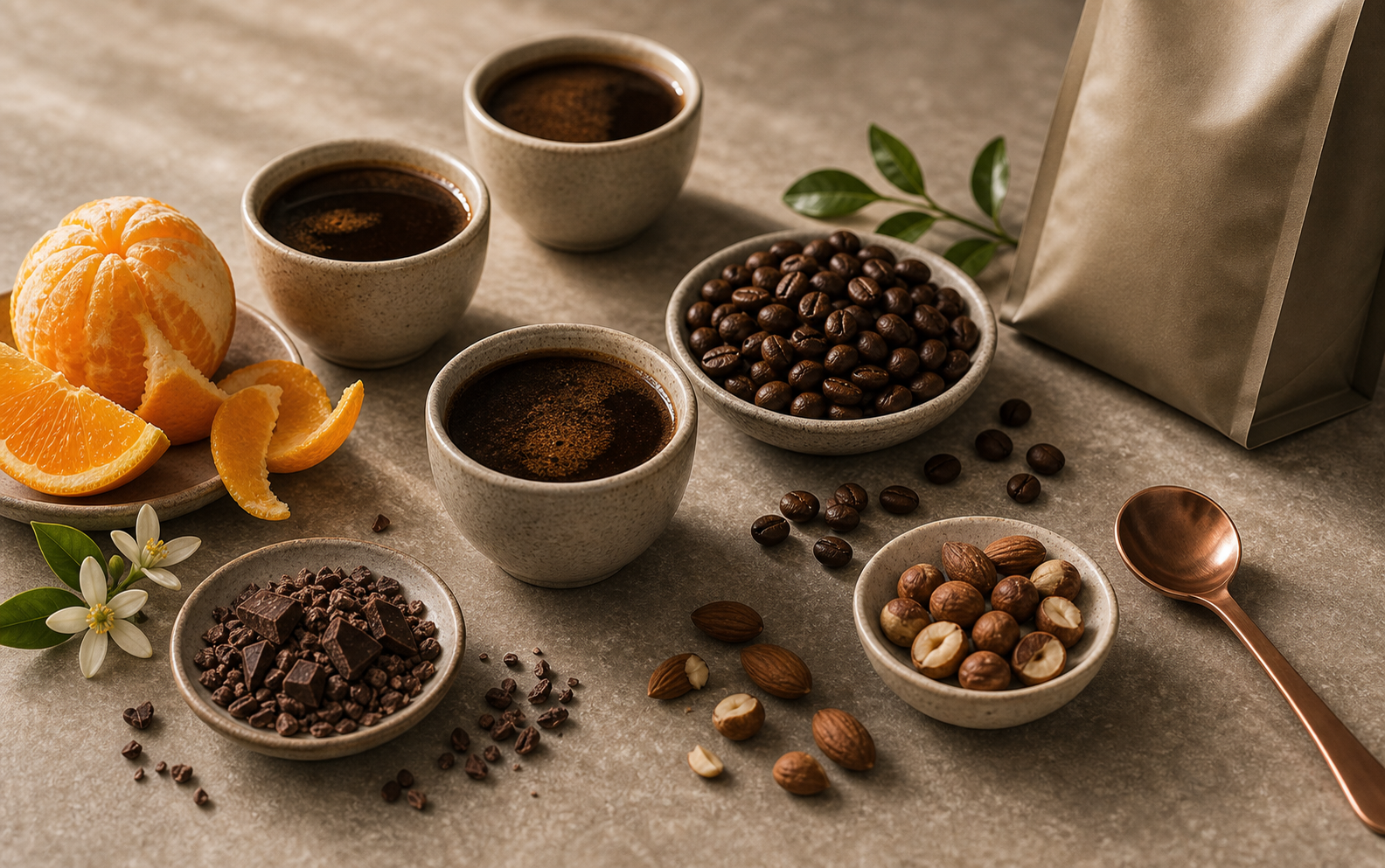
Coffee tasting notes are not ingredient lists. They are sensory comparisons: shorthand for the natural flavours and aromas that a coffee can remind you of when it is roasted and brewed well.
That distinction matters. When Out of Coffee describes chocolate, nuts, citrus, berries, florals, caramel or spice, we are not saying those ingredients were added. We are describing what the coffee itself can express through origin, process, roast profile, post-roast maturation and brewing.
Tasting notes are useful, but not literal
A note like chocolate usually points toward cocoa-like aroma, sweetness, body or roast balance. A citrus note usually points toward bright acidity and a cleaner finish. Berry or tropical fruit often suggests stronger process expression or a coffee with more obvious aromatic lift.
Those words help customers compare coffees quickly, but they should not be read like a guarantee that every cup will taste exactly like the food named on the bag. Palate, brew method, water, grind, dose, temperature, storage and drinking window all change what reaches the cup.
Coffee flavour is real chemistry
Roasted coffee contains a complex mix of volatile aroma compounds and non-volatile taste compounds. Roasting changes sugars, amino acids, acids, lipids and other precursors through Maillard reactions, caramelisation, Strecker degradation and related heat-driven reactions.
That chemistry is why coffee can resemble familiar foods without containing them. Some compounds contribute roasted, nutty, caramel, floral, fruity, spicy or smoky impressions. The final cup is not one compound. It is the balance of many signals read by smell, taste and texture together.
Origin and processing shape the raw material
The coffee’s variety, growing region, altitude, climate, picking standard, fermentation and drying all affect the material before it reaches the roaster. Washed coffees often lean cleaner and more structured. Natural coffees can carry heavier fruit and sweetness when the process is controlled well. Fermentation-driven lots can show more unusual aroma, but they also need careful roast and brew handling.
This is why two coffees roasted by the same person can taste completely different. The roaster is not inventing flavour from nothing. The roast is working with the flavour potential of the lot.
Roasting changes the balance
Roast profile decides which parts of that potential become easiest to taste. A lighter, carefully developed roast may preserve more acidity, florals and fruit clarity. More development can push the cup toward chocolate, nuts, body and roast sweetness. Too little development can taste sharp or grassy. Too much can flatten origin detail.
Out of Coffee uses lot-specific roast profiles because a generic roast setting cannot serve every coffee equally well. A coffee chosen for filter clarity and a coffee chosen for automatic-machine comfort should not automatically receive the same roast direction.
Brewing decides what you actually taste
The product note describes potential. Brewing decides the extraction. Filter brewing can make clarity, acidity and aromatics easier to read. Espresso concentrates flavour and can make sweetness, texture and imbalance more intense. Automatic machines often reward rounded, forgiving coffees because they offer less recipe control.
If a coffee’s notes seem muted, the issue is not always the note itself. It may be grind, dose, brew ratio, water, temperature, storage or coffee that has not reached a stable drinking window yet.
How to use tasting notes when buying
Use notes as a direction, then combine them with the coffee lane, brew fit and product guidance. Chocolate, nuts and caramel usually suit customers who want comfort, milk drinks or automatic-machine reliability. Citrus, florals and tea-like notes usually suit customers who enjoy clarity and filter brewing. Big fruit, fermentation and unusual notes often suit Explorer customers who want discovery.
- Notes are comparisons, not added flavouring.
- Origin and process create much of the flavour potential.
- Roast profile changes what becomes prominent.
- Brew method determines how clearly the notes show.
- Choose by flavour direction, brew method and drinking window together.
Why people taste different things
Two people can drink the same coffee and describe it differently. That does not mean one of them is lying. Sensory memory, language, experience, brew strength, temperature and what someone ate earlier can all affect description. One person may say red apple while another says cranberry. Both may be responding to the same acidity and fruit structure.
This is why Out of Coffee uses tasting notes as practical direction, not rigid promises. The note should help you understand the flavour lane. It should not make the customer feel as if they failed because they did not taste the exact fruit word.
How to compare notes fairly
Compare coffees under similar conditions. Use the same brew method, similar water, consistent ratio and a controlled grind range. Taste the coffee when it is hot, warm and cooler, because aromatics and sweetness can change as temperature drops.
When comparing two coffees, look for broad patterns first: body, acidity, sweetness, bitterness, aroma intensity and finish. Then move into specific words. Broad structure is often more reliable than chasing one exact descriptor.
When a tasting note should be challenged
A tasting note should still be honest. If a coffee is described as strawberry and floral but consistently tastes flat, woody or harsh across good brewing, the note is not doing its job. The problem may be roast, storage, age, brew method or an over-optimistic description.
Good product notes should help customers buy better. They should make the coffee easier to understand, not more mysterious.
Read next
- No artificial flavouring. Just true coffee character.
- Specialist roast profiles by lot
- Choosing coffee for filter brewing
- Shop coffee by flavour lane
Research Papers, Sources and further reading
This guide is written for customers, not as an academic paper. It is based on Out of Coffee research notes and the source areas below.
- Coffee flavour: an overview.
- Influence of provenance and roast degree on the composition of potent odorants in Arabica coffees.
- Effects of postharvest processing on aroma formation in roasted coffee – a review.
- The Effect of Roast Development Time Modulations on the Sensory Profile and Chemical Composition of the Coffee Brew.