

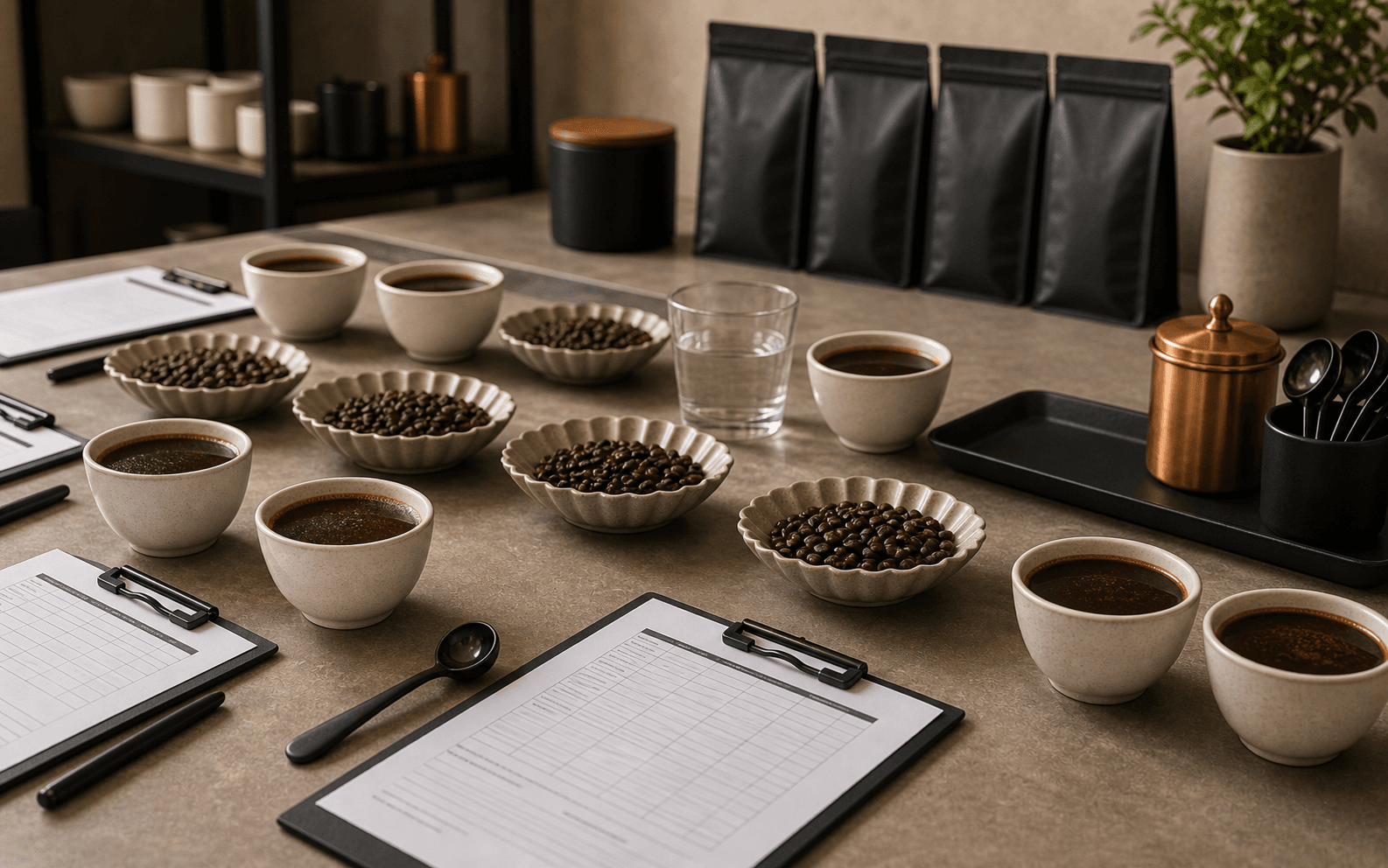
Third-party SCA grading matters because it separates a quality marker from the seller. It is stronger than a brand simply awarding itself praise.
It is still not the whole story. A score needs context: origin, process, roast, post-roast maturation, brew method and the way the customer actually drinks coffee.
What the score can do
A score can signal that the coffee has been assessed against a recognised framework by someone outside the selling brand. That helps customers compare lots with less guesswork. Where independent SCA, Q or CVA-based assessment exists, Out of Coffee can publish it as evidence rather than hype.
The strongest use of a score is proof context. It tells you there is a recognised assessment behind a quality claim. It does not remove the need to check whether the coffee suits your brew method, flavour preference or daily routine.
See the SCA scorecard
The current SCA reference is the Coffee Value Assessment set of forms. Use it as a framework for understanding what a score is built from, not as a shortcut for deciding whether a coffee will suit your brew method or taste preference.
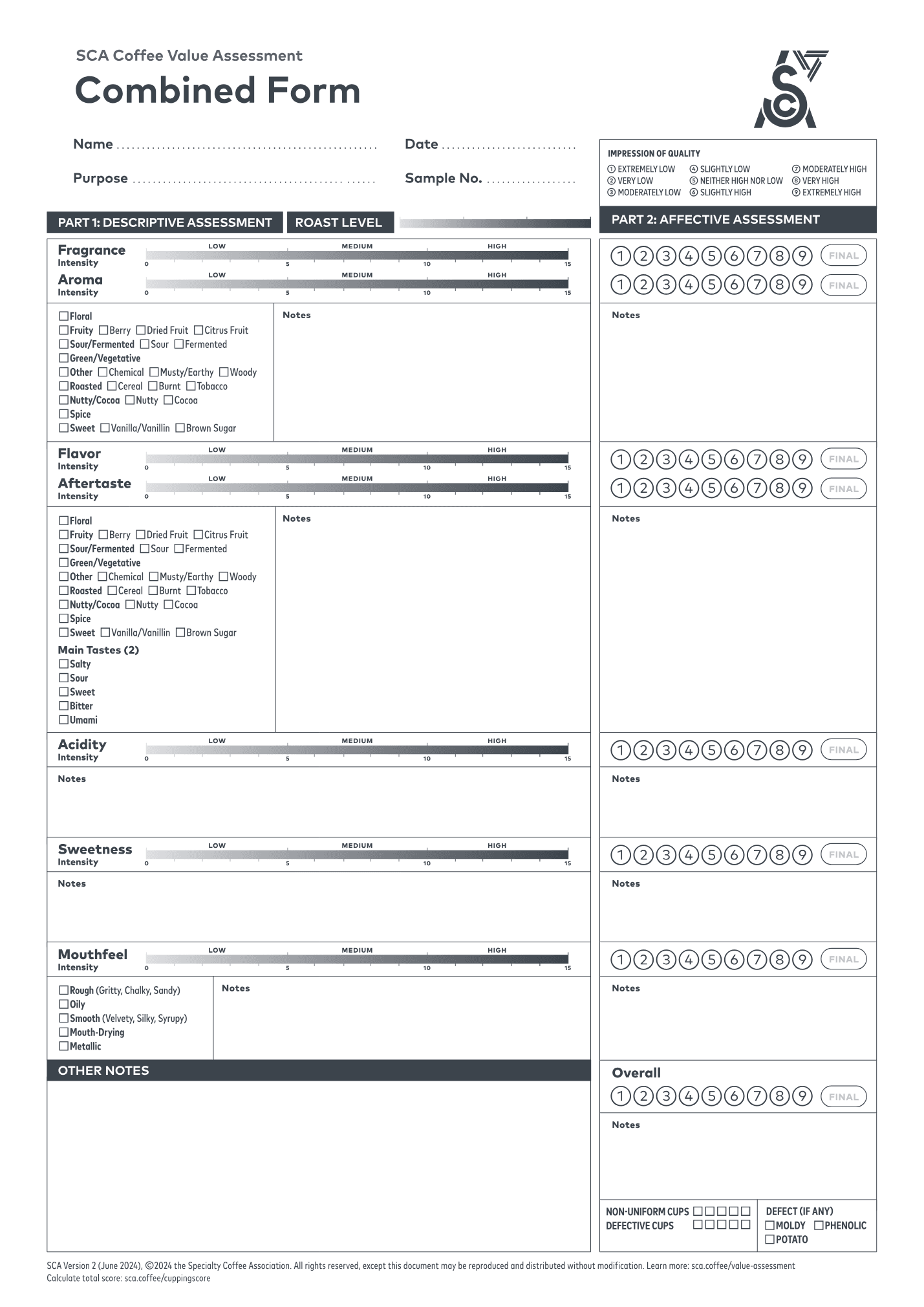
You can also read the broader SCA Coffee Value Assessment page for context around the official forms and scoring tools.
SCA, Q and CVA scores in plain language
SCA refers to the Specialty Coffee Association, a major body behind coffee standards, education and assessment frameworks. Q grading refers to calibrated coffee evaluation work associated with licensed graders and recognised protocols. CVA means Coffee Value Assessment, the newer SCA framework designed to describe coffee value with more structure and nuance.
The terminology matters because the industry has been moving beyond one-dimensional score language. A score is still helpful, but modern coffee assessment also cares about descriptive, affective and contextual information.
What the score cannot do
A score cannot tell you whether the coffee fits your automatic machine, your milk drink, your acidity preference or your brew recipe. A high score does not mean every customer will prefer that coffee. Some customers want comfort, chocolate and body. Others want acidity, florals and fruit.
A higher-scoring coffee may be more complex but less suitable for a specific machine, milk drink or office environment. That is why we treat scores as proof markers, not as the only hierarchy. Score helps answer “is there independent quality evidence?” It does not fully answer “is this the best coffee for my setup?”
Why third-party proof matters
Independent assessment reduces the conflict of interest that appears when a seller simply praises its own product. Where a lot has reliable third-party scoring or assessment records, we use that as evidence rather than self-awarded marketing language.
The score is strongest when it sits beside origin, process, roast profile, drinking window and brew-fit guidance. That combination makes the information more useful for customers. For Out of Coffee, the safest phrase is “third-party SCA, Q or CVA-based assessment where available.”
How to use scores when buying coffee
Use the score to understand quality context, then use the rest of the page to decide fit. If you use an automatic machine, a very complex high-acidity coffee may not be the safest first choice. If you brew filter and want clarity, the same coffee may be exactly what you want.
Out of Coffee will not invent scores. Where independent assessment exists, we use it. Where it does not, we lean on honest flavour direction, roast approach, brew fit and product context.
- Use scores as evidence, not as a preference command.
- Check whether the coffee fits your brew method.
- Read tasting notes as direction, not exact ingredient promises.
- Prioritise the coffee that fits how you actually drink.
How Out of Coffee publishes scores
When a coffee has third-party SCA grading or related external assessment, we use that wording as a proof marker. We do not turn the score into a personality test for the coffee, and we do not use vague proof language when a more exact marker is available.
The useful question is not only “what did it score?” The better question is “what does this score mean alongside origin, process, roast profile, drinking window, brew method and the way I drink coffee?”
What if there is no score?
A missing public score does not automatically mean a coffee is poor. Some lots may not have a published third-party score available to us, or the buying decision may rely more on roast testing, cup performance and fit for a specific use. Where a score exists, we publish it with context. Where it does not, the product still needs clear flavour, brew-fit and quality information.
Read next
- Easy Drinking vs Explorer range
- Coffee tasting notes explained
- No artificial flavouring. Just true coffee character.
- Shop coffees with proof markers
Research Papers, Sources and further reading
This guide is written for customers, not as an academic paper. It is based on Out of Coffee research notes and the source areas below.
- Official SCA CVA forms and scorecard PDF.
- Specialty Coffee Association Coffee Value Assessment.
- SCA Adopts Three New Cupping Standards Based on the Coffee Value Assessment.
- Q Grader Calibration and Recertification Policy.
- Valuing Coffee: Evolving the SCA’s Cupping Protocol into a Coffee Value Assessment System.