

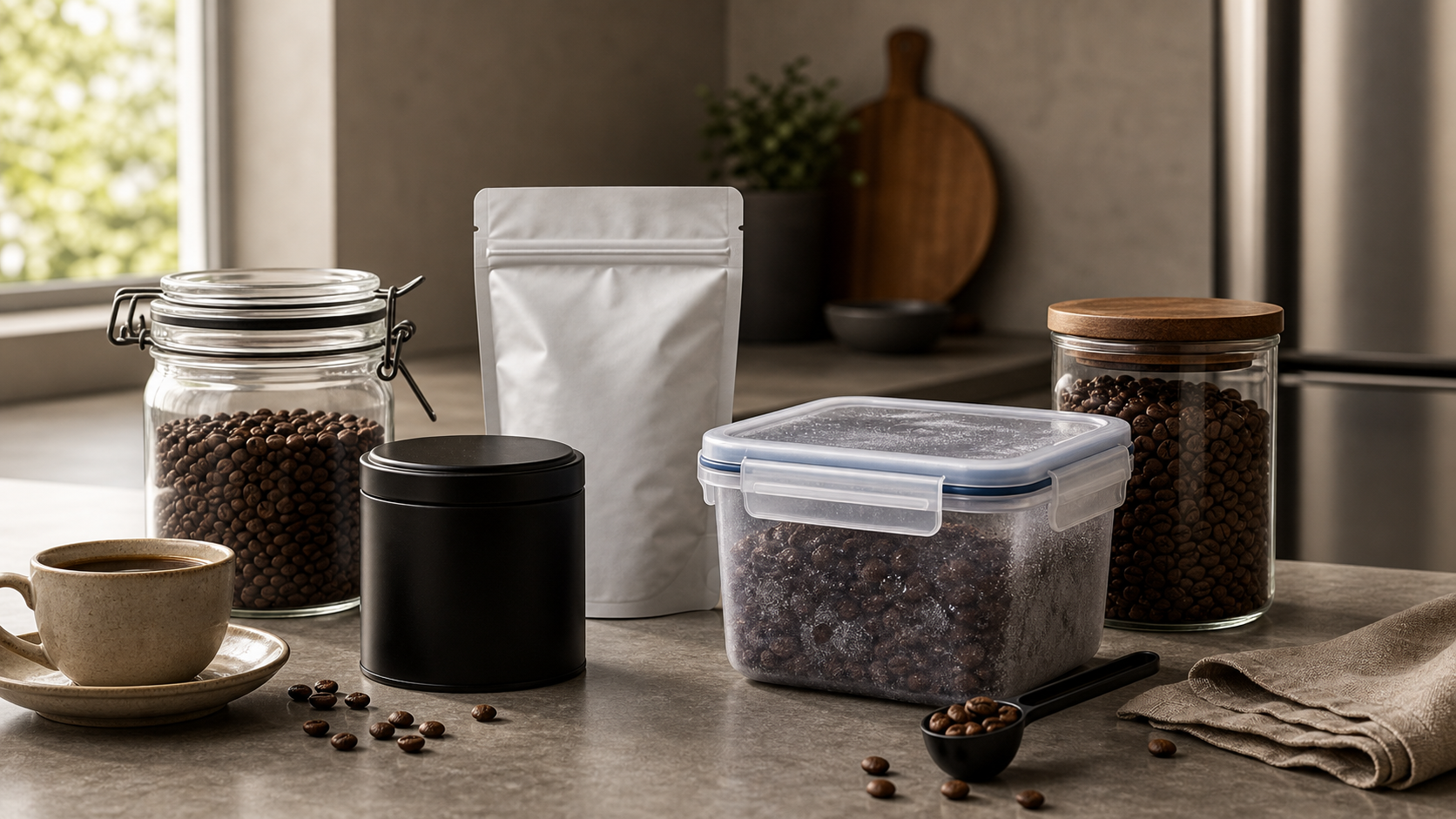
Once a coffee bag is opened, storage starts to matter more. Oxygen, moisture, heat, light and grind state all influence how quickly coffee moves out of its best drinking window.
Good storage will not turn bad coffee into good coffee. It will not reverse staling. What it can do is slow decline and help a good coffee remain expressive for longer.
The main enemies are oxygen, moisture and heat
Oxygen drives many of the changes people describe as stale, flat or tired. Moisture can make coffee deteriorate faster and can introduce unpleasant flavours. Heat speeds change. Light is usually less important than oxygen and heat, but it is still easy to avoid.
The practical rule is simple: keep coffee sealed, cool, dry and away from repeated air exposure. Avoid the stove, kettle, dishwasher, warm counters and sunlight. A display jar may look good, but it usually stores coffee worse than a sealed bag in a cupboard.
Keep whole bean when possible
Whole beans protect aroma better than ground coffee because less surface area is exposed. Once coffee is ground, oxygen can reach far more of it at once. If you own a grinder, grind only what you need. If you buy ground coffee, buy smaller amounts, reseal carefully and finish it sooner.
This matters especially after the coffee has reached a good drinking window. You want to protect the flavour stage you paid for, not speed the coffee toward flatness by exposing it to air and moisture every day.
Use the bag correctly
If the bag seals well, use it. Push out excess air gently, seal it fully and store it in a cool cupboard away from heat and steam. If the bag does not reseal well, transfer coffee into a clean airtight container.
- Best daily method: whole bean, sealed bag, cool dry cupboard.
- For pre-ground coffee: buy less, seal tightly and finish faster.
- Avoid: fridge storage, steam, warm counters, clear display jars and repeated opening.
Freezing roasted coffee without ruining it
Freezing roasted coffee is not a magic fix. It cannot rescue bad coffee, reverse staling or make careless storage irrelevant. Used correctly, freezing is a practical way to slow change once the coffee is already in a good drinking window.
A simple way to think about flavour development is this: during roasting, heat-driven reactions such as Maillard reactions, Strecker degradation, caramelisation and related breakdown reactions create many of the aroma compounds we enjoy. After roasting, the coffee keeps changing as carbon dioxide leaves, volatile aromatics fade and oxygen slowly drives staling reactions. Freezing does not make coffee fresher, but when coffee is sealed properly it greatly slows those post-roast changes, helping the beans stay closer to the flavour window you froze them in.
When freezing makes sense
Freezing makes sense when you have more coffee than you can finish while it is tasting good. It is especially useful for larger bags, special lots, decaf you drink slowly or a coffee you want to preserve after it has settled.
Portion before freezing
The biggest mistake is freezing one big bag and opening it repeatedly. Each open-and-close cycle brings air, moisture and temperature change. Instead, divide the coffee into practical portions. Seal each portion well. Freeze the portions you are not using yet.
Avoid moisture
Moisture is the enemy. When cold coffee meets warm humid air, condensation can form on the beans. That can damage flavour quickly. Remove only the portion you need and let it come to room temperature while still sealed. Open it only once the outside of the container is no longer cold.
What not to freeze
Do not freeze coffee that is already stale and expect it to become lively. Do not freeze loose coffee in a half-open bag. Do not move coffee repeatedly between freezer and counter. Freezing works best as a preservation tool for coffee you already like.
- Freeze sealed portions, not one repeatedly opened bag.
- Let portions warm while sealed.
- Avoid moisture and repeated thawing.
- Use freezing to slow decline, not to repair old coffee.
Practical storage summary
For daily use, keep the coffee sealed, cool and dry. For longer holding, freeze sealed single-use or short-use portions after the coffee has reached a flavour stage you want to preserve. Do not confuse controlled resting with neglect: oxygen, heat, moisture and repeated opening shorten the window.
Read next
- Roast date vs drinking window
- How brew method changes coffee flavour
- Choosing coffee for automatic machines
- Shop coffee in practical bag sizes
Research Papers, Sources and further reading
This guide is written for customers, not as an academic paper. It is based on Out of Coffee research notes and the source areas below.
- Effects of different coffee storage methods on coffee freshness after opening of packages.
- The Effects of Storage Temperature on the Aroma of Whole Bean Arabica Coffee Evaluated by Coffee Consumers and HS-SPME-GC-MS.
- Effects of postharvest processing on aroma formation in roasted coffee – a review.
- Sulfury/roasty fading indicators in roasted coffees: Their contribution and applicability in coffee freshness perception and prediction.
- Effect of Temperature and Storage on Coffee’s Volatile Compound Profile and Sensory Characteristics.