

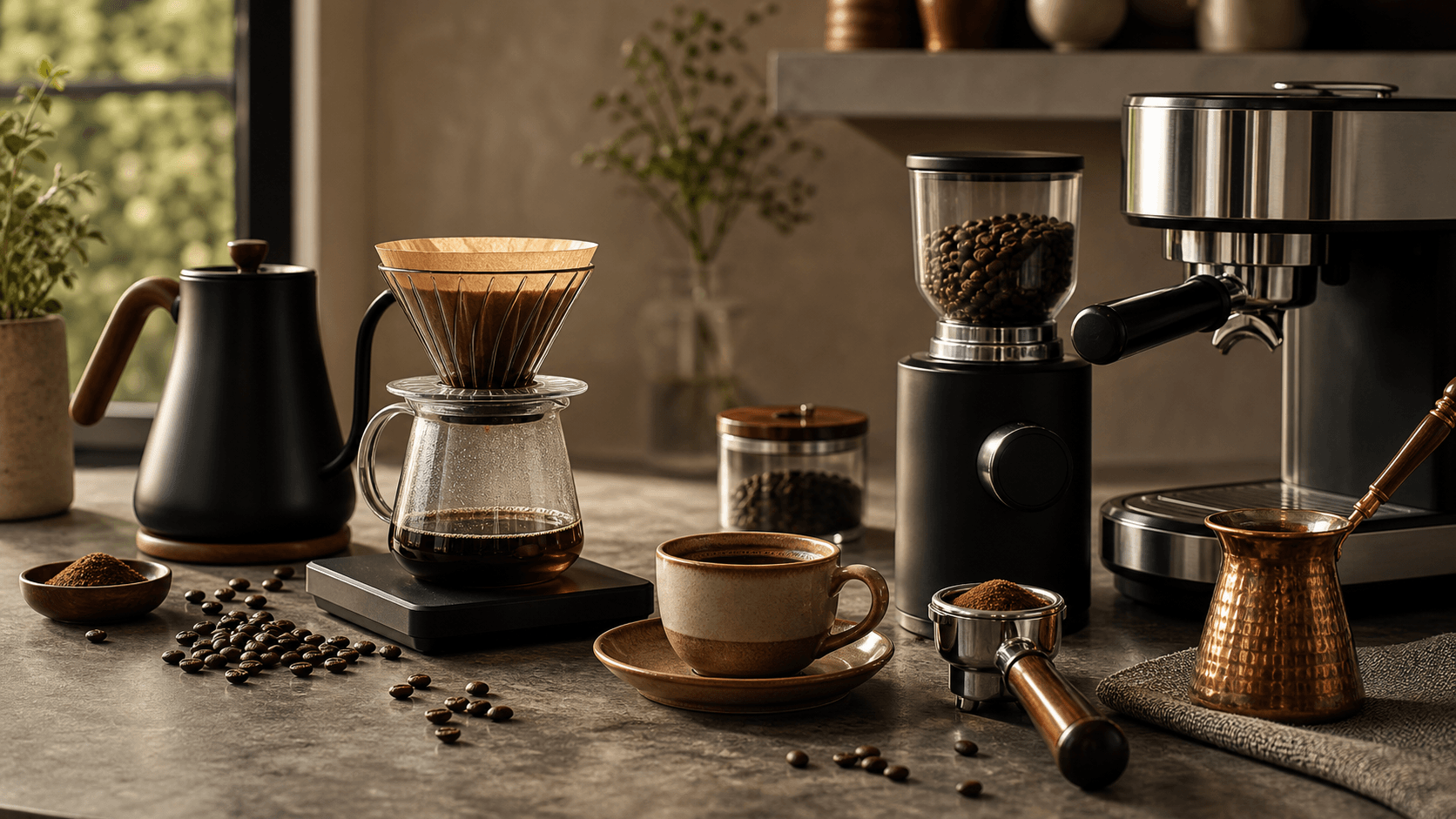
The same coffee does not taste identical in every brew method. Filter / pour-over, espresso, automatic machines, moka pot, French press / immersion, AeroPress, Turkish-style brewing and cold brew all change how water extracts flavour from the same roasted beans.
That is why Out of Coffee matches coffees to brew methods instead of treating method as a decoration on the product page. The roast, origin, process and resting window matter, but the brewing system decides how much of that chemistry reaches the cup, how concentrated it feels, and how forgiving the coffee is in daily use.
The extraction variables that matter
Coffee brewing is controlled extraction. Hot or cold water dissolves soluble compounds from ground coffee, carries oils and small particles into the drink, and leaves some material behind in the spent grounds. The final flavour depends less on one magic recipe than on how several variables work together.
- Ratio: the mass of coffee compared with water changes strength, body and perceived balance.
- Grind size: finer grounds expose more surface area and slow water movement; coarser grounds extract more slowly.
- Contact time: a short espresso shot, a three-minute AeroPress and a twelve-hour cold brew do not extract on the same timeline.
- Temperature: hotter water extracts many compounds faster; cooler water can soften acidity and bitterness but needs more time.
- Pressure and flow: espresso and many automatic machines push water through a compact bed. Filter and immersion brewing depend more on gravity, turbulence and diffusion.
- Filtration: paper, metal, cloth and sediment-based brewing all change how much oil and fine material reaches the cup.
A method is therefore not only a serving style. It is a different extraction environment. A delicate washed Ethiopia can taste clean and floral in filter brewing, vivid in AeroPress and demanding in espresso. A rounded Brazil can feel steady in an automatic machine, sweet in moka pot and comforting in milk.
Serious espresso setups
Espresso uses fine grinding, a compact coffee bed, high pressure and a small beverage mass. That makes it intense. It also makes it unforgiving. Small changes in dose, grind, distribution, puck prep, temperature, yield or shot time can move the cup from sweet and textured to sharp, hollow, harsh or muddy.
A proper espresso setup with a capable grinder gives more control over dose, grind, distribution, yield and recipe. That control can make complex coffees shine, but user technique matters more. A high-acidity or delicate coffee may be excellent, but it will punish poor grinding or puck prep faster than a rounded daily profile.
Choose espresso-suitable coffees when you want intensity, milk compatibility or concentrated sweetness. For milk drinks, prioritise body, sweetness and chocolate or nut direction. For black espresso, decide whether you want comfort or acidity and clarity. For unusual lots, expect more dial-in work.
Espresso also shows why resting matters. Very fresh coffee can make espresso difficult because gas release affects flow and extraction. Letting coffee settle into a drinking window often makes dial-in easier. If your shots are still inconsistent, the physical setup matters too: read our espresso headspace, puck height and shower-screen clearance guide.
Automatic machines vs serious espresso setups
An automatic coffee machine can make a good daily cup. A serious espresso setup can reveal more control and more detail. They are not the same buying context. The right coffee depends on what the equipment can actually do.
Automatic machines are built for repeatability and ease. They handle grinding, dosing and brewing with limited user input. The trade-off is control. Many automatic machines offer less precision over grind, distribution, pressure behaviour, temperature and yield than a dedicated espresso setup.
A higher-scoring coffee is not automatically better in an automatic machine. Score gives quality context, but machine fit decides whether that quality becomes obvious in your cup. A coffee can be excellent and still be a poor first choice for a particular machine. That is practical extraction advice, not gatekeeping.
Choosing coffee for automatic machines
Automatic machines are useful because they make coffee convenient. They are especially valuable for homes and offices where several people need a reliable cup without manual dial-in work. That means the best coffee is not always the most complex or highest-scoring lot. It is the coffee that the machine can brew consistently.
Rounded coffees with chocolate, nuts, caramel, cocoa, low-to-moderate acidity and solid body are safer in many automatic machines. They tolerate narrower recipe control and still produce a balanced daily cup. Very delicate coffees can taste thin, sharp or inconsistent if the machine cannot grind fine enough, heat consistently or manage the puck evenly.
- Start with Easy Drinking coffees or products marked automatic friendly.
- Move into the Explorer range only when you understand how your machine handles acidity, grind settings and recipe strength.
- Keep the grinder path clean, adjust strength gradually, use fresh water and avoid judging a new coffee from one cup.
- Remember that automatic machines can need several shots to settle after a grind or bean change.
Filter / pour-over: clarity and origin character
Filter brewing is often the clearest way to understand origin character. It usually uses more water, less pressure and paper filtration. That combination can reduce heaviness and make aroma, acidity and sweetness easier to separate.
If you want clarity, look for washed coffees, higher-acidity lots, florals, citrus, tea-like notes or clean fruit. the Explorer range often make sense in filter because the method can reveal detail without compressing everything into a tiny cup. If you want comfort, choose rounded coffees that still hold sweetness without needing milk.
Recipe still matters. Grind size, water temperature, pouring, ratio and contact time can all move the cup. Under-extraction can taste thin and sour. Over-extraction can taste dry and bitter. The product can be good and the brew can still miss.
Moka pot, French press, AeroPress and cold brew
A moka pot produces a strong, compact cup, but it is not the same as espresso. It usually suits coffees with sweetness, body and enough roast development to stay balanced under intensity.
French press and other immersion methods give body, oils and softer edges because coffee and water sit together before separation. The trade-off is less clarity. Use immersion when cocoa, caramel, dried fruit, spice or rounded comfort matter more than sparkling acidity.
AeroPress sits between categories. It can behave like short immersion, a filtered concentrate, a cleaner travel brewer or a strong cup diluted after brewing. That flexibility makes it useful for many Out of Coffee lots.
Cold brew uses much lower temperature and much longer contact time. It tends to reduce perceived acidity and soften volatile aromatics. It can feel smooth, sweet and easy to drink, but it may hide some of the high notes that make a careful filter brew exciting.
Turkish-style brewing: very fine grind and high extraction intensity
Turkish-style brewing is not espresso, but it can feel intense because it puts a lot of extracted material in a small cup. The method uses an extremely fine grind, full immersion and no final paper filtration. Fine particles and oils contribute to texture and body, creating a dense, aromatic and sediment-driven cup.
Coffees with body, sweetness, chocolate, nuts, spice or lower sharp acidity tend to be more forgiving. Very delicate floral coffees can work, but they are easier to overwhelm. If you want a comfortable Turkish-style cup, start with Easy Drinking profiles before moving into more expressive Explorer lots.
Roast and freshness still matter. Because Turkish-style brewing uses such fine grinding, stale or poorly stored coffee can taste flat quickly. At the same time, very fresh coffee can behave unpredictably. A coffee inside a good drinking window, stored well and ground just before brewing, gives the method its best chance.
Method-by-method buying guide
| Brew method | Usually highlights | Choose coffees with |
|---|---|---|
| Filter / pour-over | Clarity, acidity, aromatics, origin detail | Florals, citrus, stone fruit, tea-like structure, clean processing |
| Espresso | Concentration, sweetness, texture, intensity | Enough sweetness and body for pressure extraction; careful setup for delicate lots |
| Automatic machines | Convenience, repeatability, daily balance | Chocolate, nuts, caramel, cocoa, lower acidity and forgiving roast structure |
| Moka pot | Heavy body, compact strength, roast sweetness | Chocolate, caramel, nuts, dried fruit, low-to-moderate acidity |
| French press / immersion | Body, oils, softer edges | Cocoa, spice, dried fruit, caramel, rounded fruit and medium-to-full body |
| AeroPress | Flexible clarity or body depending on recipe | Most profiles, especially fruit-forward lots and coffees needing controlled intensity |
| Turkish-style | Dense texture, aromatics, high extraction intensity | Bold body, cocoa, spice, dried fruit and low-acidity comfort |
| Cold brew | Smooth sweetness, muted acidity, easy drinking | Natural fruit, chocolate, caramel, cocoa and rounded body |
How Out of Coffee uses brew fit on products
Our product pages use brew fit as a practical recommendation, not as a strict rule. If a coffee lists Filter / pour-over, Espresso and AeroPress, that means those methods are sensible places to start. It does not mean the coffee cannot be brewed another way.
Use the product’s brew-method guidance together with the tasting notes, process, roast direction, SCA score where available and the best-use note. If you are unsure, start with the method that gives you the most control. Filter / pour-over and AeroPress are forgiving places to learn a coffee. Automatic machines are best matched with forgiving coffees. Espresso rewards precision.
Read next
- Choosing coffee for automatic machines
- Choosing coffee for espresso setups
- Choosing coffee for filter brewing
- Espresso headspace, puck height and basket fit
- Shop coffee by brew setup
Research Papers, Sources and further reading
This guide is written for customers, but it follows the same extraction logic used in coffee research: brew ratio, grind, temperature, time, pressure, filtration and bed behaviour all influence the chemical and sensory result.
- Coffee extraction: A review of parameters and their influence on the physicochemical characteristics and flavour of coffee brews.
- Comparison of nine common coffee extraction methods: instrumental and sensory analysis.
- Systematically Improving Espresso: Insights from Mathematical Modeling and Experiment.
- An equilibrium desorption model for the strength and extraction yield of full immersion brewed coffee.
- Influence of particle size distribution on espresso extraction via packed bed compression.
- Time-resolved extraction of caffeine and trigonelline from finely-ground espresso coffee with varying particle sizes and tamping pressures.
- Influence of Flow Rate, Particle Size, and Temperature on Espresso Extraction Kinetics.
- Effects of postharvest processing on aroma formation in roasted coffee – a review.
- The Effect of Roast Development Time Modulations on the Sensory Profile and Chemical Composition of the Coffee Brew.
- Effects of different coffee storage methods on coffee freshness after opening of packages.